
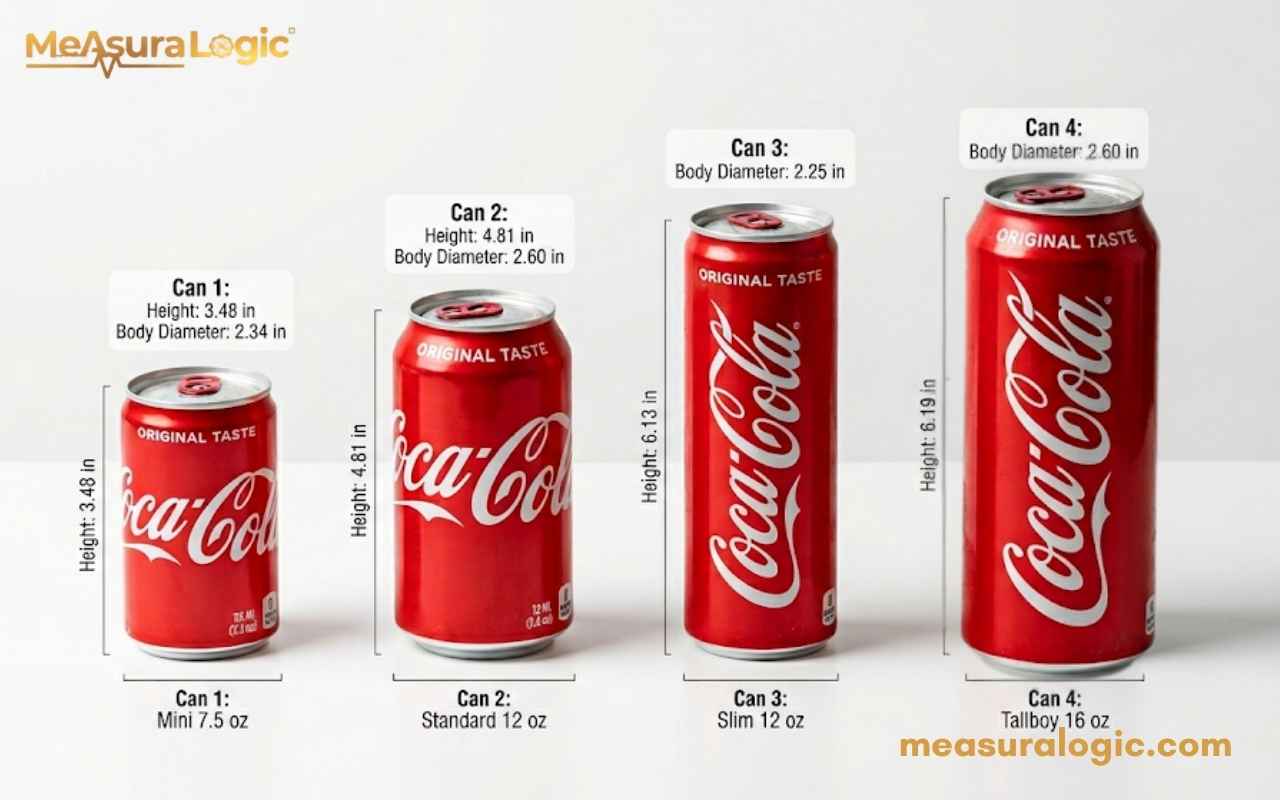
You have held one a thousand times. But do you actually know the exact coke can dimensions? Whether you are an engineer, a designer, a curious mind, or someone trying to figure out how many cans fit in a cooler, this guide covers everything. Every size, measurement and reason behind the precision.
History of coke
Coca-Cola was first made in Atlanta, Georgia, in 1886, when pharmacist John Stith Pemberton stirred up a caramel-colored syrup and sold it for five cents a glass as a headache remedy. Businessman Asa Candler bought the formula for $2,300 in 1888 and turned it into a global empire. Today, Coke sells in over 200 countries all from a backyard kettle and a five-cent idea.
Read about 17 Common Things That Are 18 Inches Long (Real Life Examples)
The Standard 12 oz Coke Can
The standard Coke can is the most produced beverage container on the planet. Here is what the numbers actually look like:
| Measurement | Imperial | Metric |
|---|---|---|
| Height | 4.812 inches | 122.2 mm |
| Body diameter | 2.602 inches | 66.1 mm |
| Lid diameter | 2.14 inches | 54.4 mm |
| Wall thickness | ~0.004 inches | ~0.10 mm |
| Empty weight | ~0.5 oz | ~14.7 g |
| Full weight | ~13.3 oz | ~375 g |
Notice something? The lid diameter is narrower than the body diameter. That is not a design choice, it is engineering. The necking process (where the top of the can is mechanically pinched inward) saves aluminum. Across billions of cans, that adds up fast.
“The aluminum can is one of the most engineered everyday objects ever made.” — Aluminum Association
The standard soda can holds 355 ml of liquid and operates under roughly 90 psi of internal pressure. That pressure is what keeps the can rigid despite walls thinner than a human hair.
Every Coke Can Size, Measured
Coke can sizes span a surprisingly wide range. Here is every format you will find in the wild.
| Can Format | Height | Body Diameter | Volume (ml) | Common Market |
|---|---|---|---|---|
| Mini 7.5 oz | 3.48 in / 88.4 mm | 2.34 in / 59.5 mm | 222 ml | USA |
| 8 oz | 3.69 in / 93.7 mm | 2.60 in / 66.1 mm | 237 ml | USA (specialty) |
| Standard 12 oz | 4.81 in / 122.2 mm | 2.60 in / 66.1 mm | 355 ml | Global |
| Slim 12 oz | 6.125 in / 155.6 mm | 2.25 in / 57.1 mm | 355 ml | USA/Europe |
| Tallboy 16 oz | 6.19 in / 157.2 mm | 2.60 in / 66.1 mm | 473 ml | USA |
| 24 oz | 8.68 in / 220.5 mm | 2.60 in / 66.1 mm | 710 ml | USA |
Anatomy of a Coke Can — More Than Just a Cylinder
Read about 16 Things That Are 100 Feet (ft) Long
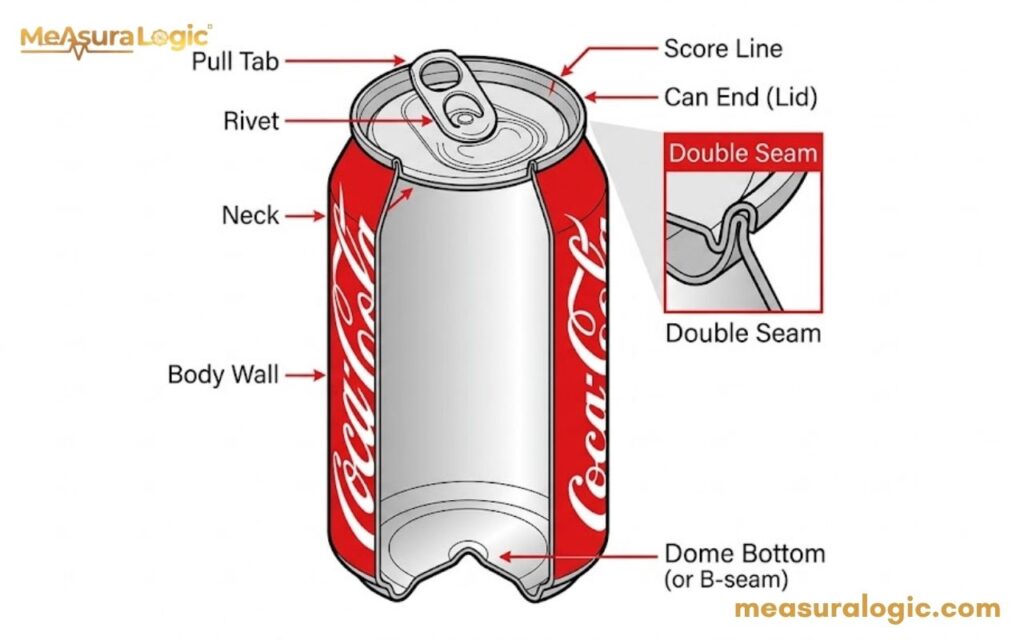
Most people think a Coca-Cola can is simple. It is not. Here is what you are actually holding:
- Body: The cylindrical span, made from one piece of aluminum drawn and ironed into shape
- Neck: The narrowed section near the top, created by a necking press
- Lid (End): A separate piece seamed onto the body; sized in industry terms as “202” (2-2/16 inches across)
- Double seam: Where the lid crimps onto the body; adds structural integrity
- Dome bottom: The inward-curved base that distributes internal pressure evenly (flat bottoms would bulge and topple)
- Pull tab: Scores the lid for opening; typically 1.3 inches long
Coke Can Dimensions by Country
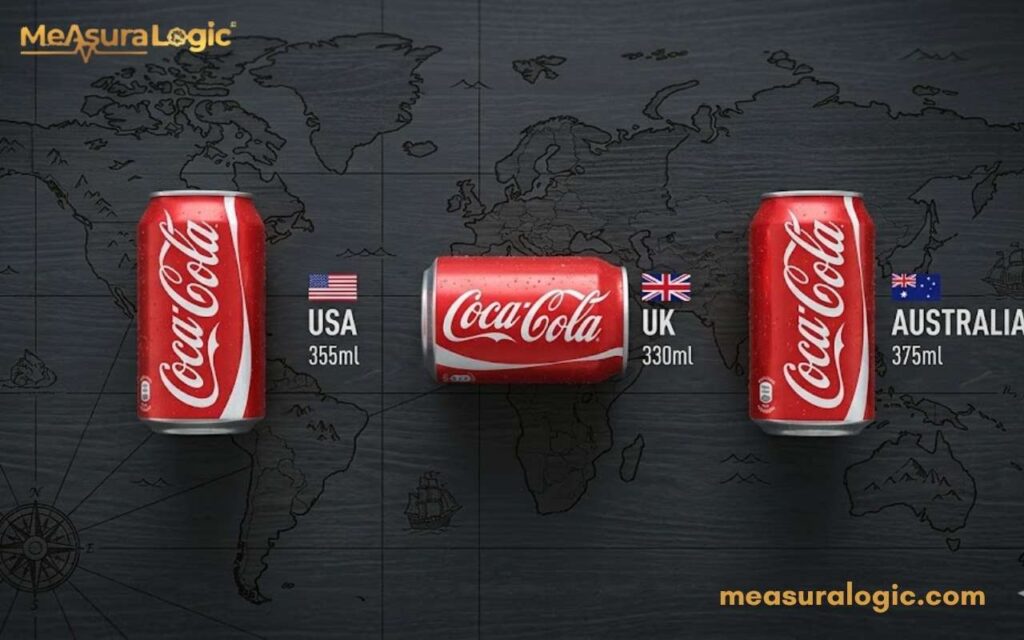
Beverage can specs are not universal. Different countries use different standard soda can sizes.
| Region | Standard Volume | Height | Notes |
|---|---|---|---|
| USA | 12 oz (355 ml) | 4.81 in | Most common globally |
| UK / Europe | 330 ml | 4.69 in / 115 mm | Slightly shorter than US |
| Australia | 375 ml | 4.96 in / 126 mm | Taller than UK standard |
| Japan | 350 ml | 4.80 in / 122 mm | Near-identical to US |
| South America | 350 ml | 4.80 in / 122 mm | Varies by country |
The UK’s 330 ml can is noticeably shorter than the American standard 12 oz. That 25 ml gap represents cost savings in aluminum and liquid. Next time you grab a Coke abroad, you are not imagining it. It is smaller.
Slim & Sleek Cans — Same Drink, Different Shape

Slim cans are having a moment. Same 355 ml volume as a standard can, but taller and narrower. Think Diet Coke’s iconic look, or the premium Coke cans at upscale restaurants.
Slim vs. Standard 12 oz — Side by Side:
| Spec | Standard 12 oz | Slim 12 oz |
|---|---|---|
| Height | 4.81 in | 6.13 in |
| Body diameter | 2.60 in | 2.25 in |
| Volume | 355 ml | 355 ml |
| Look | Classic | Modern/premium |
The skinny soda can communicates “premium” without changing a drop of the product. It is pure packaging psychology and it works.
Learn about, 20 Feet: 24 Real Things That Are About This Long
The Engineering Behind the Precision

Aluminum can manufacturing runs to tolerances tighter than most machined parts. Here is why:
- Wall thickness: ~0.004 inches (thinner than a credit card’s magnetic stripe)
- Internal pressure: 90 psi, enough to make a flat-bottomed can catastrophically fail.
- Necking: Each can passes through multiple necking dies to reduce the top diameter in stages. You can not do it in one press without cracking the metal.
- Lidding: The 202 end size (lid diameter) became an industry standard specifically to reduce aluminum use while maintaining seal integrity.
- Weight over time: A 1970s Coke can weighed about 21g empty. Today’s recyclable packaging weighs ~14.7g. Engineers shaved off 30% without weakening it.
Every fraction of a millimeter matters because vending machine slots, packing machinery, and refrigerator shelves are all calibrated to these specs.
Coke Can vs. Other Beverage Cans

Here is how the iconic Coca-Cola can stacks up against the competition:
Explore About Lake Michigan: Guide to Size, Depth, Geography & Impact
| Can | Height | Body Diameter | Volume |
|---|---|---|---|
| Coke 12 oz | 4.81 in | 2.60 in | 355 ml |
| Pepsi 12 oz | 4.81 in | 2.60 in | 355 ml |
| Red Bull 8.4 oz | 5.10 in | 2.06 in | 250 ml |
| Budweiser 12 oz | 4.81 in | 2.60 in | 355 ml |
| Coke Tallboy 16 oz | 6.19 in | 2.60 in | 473 ml |
How Coke Can Dimensions Changed Over Time
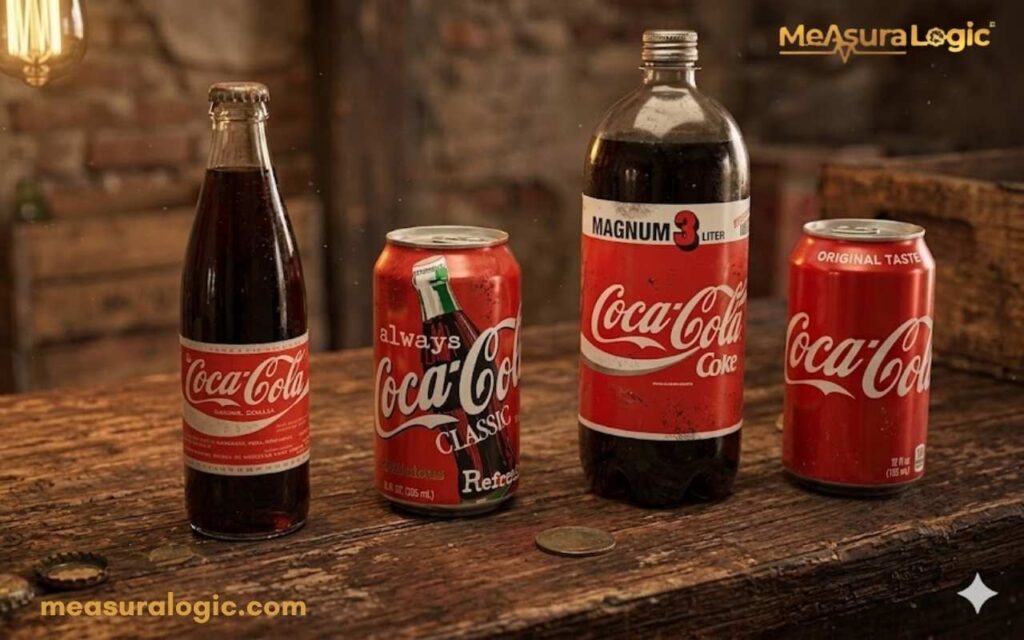
The aluminum can was not always aluminum and it was not always this shape.
- 1930s: Steel cans, opened with a church key tool. Much heavier, thicker walls
- 1958: Aluminum enters the picture. Coors first, then the industry followed
- 1960s: The pull tab is invented, eliminating the church key forever
- 1980s: The stay-on tab replaces the pull tab (no more litter)
- 1990s: Wall thickness starts dropping as metallurgy improves
- 2009: Coca-Cola introduces the mini 7.5 oz in the US market
- 2012–present: Slim and sleek formats expand globally for premium lines
The biggest quiet revolution? Lightweighting. Nobody talks about it but it is remarkable, the same product stature, less than 70% of the original material.
Practical Uses for Knowing Coke Can Measurements

Real people need these soda can measurements for real reasons:
Find about, Alaska Dimensions: How Big Is Alaska?
DIY & Crafting
- Speaker amplifiers built from stacked cans
- Pendant lamps using cut aluminum bodies
- Planters, pen holders, wall art
Storage & Logistics
- A standard fridge shelf fits 8–10 cans side by side
- A 24-pack case measures roughly 19 × 5 × 5 inches
- A standard pallet holds approximately 7,680 cans
Design & Tech
- CAD and 3D modeling reference object (everyone knows the size)
- Photography scale reference
- Vending machine slot calibration — slots are 2.65 inches wide, leaving ~0.05 inches clearance
Fun Facts You Probably Didn’t Know
- Coca-Cola produces roughly 2 billion servings every single day — that is enough cans stacked end to end to circle the Earth more than 5 times daily.
- The aluminum in a Coke can is fully recyclable and back on shelves within 60 days — making it one of the most efficiently recycled products on the planet.
- A Coke can withstands up to 90 psi of internal pressure — yet its walls are thinner than a human fingernail. That is not luck. That is decades of aerospace-grade engineering.
Conclusion
The humble Coke can is an engineering marvel hiding in plain sight. From the body to the dome bottom, from the 7.5 oz to the 16 oz, every dimension exists for a reason. Next time you open one, you are holding decades of metallurgical refinement in your hand at a wall thickness thinner than a hair. That is not an accident. That is precision.
Quick Challenge: Can You Guess It?
Learn About, 2 Inches: 18 Everyday Items That Help You Visualize Measurement
Without grabbing a ruler — how tall do you think a standard Coke can is?
Take your best guess, then scroll back up to the measurements table to check your answer.
Most people guess wrong by at least half an inch.
Did you nail it?
Drop your guess in the comments below!
Frequently Asked Questions
Is a Coke can the same size as a beer can?
Yes, a standard 12 oz beer can shares identical can dimensions with a Coke can.
What does the 202 end size mean?
It is an industry code for the lid diameter: 2 and 2/16 inches. Smaller ends use less aluminum.
How many Coke cans fit on a standard fridge shelf?
Typically 8 to 10 cans standing upright, or up to 14 laying on their sides.
Learn about 18 Things That Are 9 Inches Long

Maria Gold is an experienced blogger for Measura Logic, specializing in the fascinating world of dimensions. With a passion for clarity and precision, she breaks down complex concepts related to measurement, size, and spatial relationships. Her insightful articles help readers understand the true logic and implications of different dimensions, from the physical to the theoretical.