

Can you actually picture 100 feet in your mind right now?
Most people think they can until they try. It sounds simple, yet the scale, size, and distance quickly become confusing without a real reference. Numbers alone do not help much. What you need is something tangible, something you can see in your head.
That is exactly what this guide does.
Instead of repeating the same old examples, you will explore real-world things that are 100 ft long, starting with unique comparisons most articles miss. Along the way, you will also learn how to visualize, estimate, and understand the true dimensions of this length in everyday life.
How Long Is 100 Feet? (The Quick Reference)
Before we dive into the comparisons, let’s lock in the mathematical foundation. Understanding the conversions helps bridge the gap between different measurement systems used globally.
| Unit | Measurement |
| Feet | 100 ft |
| Meters | 30.48 m |
| Yards | 33.33 yd |
| Inches | 1,200 in |
| Miles | 0.019 mi |
| Centimeters | 3,048 cm |
The “Rule of Thumb” Estimates
- Walking Pace: It takes the average adult about 22 to 25 seconds to walk 100 feet at a brisk, purposeful pace. If you are strolling casually, it may take up to 30 seconds.
- The Car Rule: It is roughly the length of 7 standard sedans parked bumper-to-bumper.
- The Sports Rule: It is about one-third of a standard American football field (including the end zones).
Read about how long is 5 inches?
Why 100 Feet Is Hard to Visualize
Here’s the truth: your brain isn’t built for abstract numbers.
You don’t naturally think in feet (ft) or meters. Instead, you understand physical reality through everyday objects, like cars, buildings, and sports fields.
That’s why spatial estimation works better when you connect numbers to real things.
- Numbers = abstract
- Objects = relatable
- Comparisons = clarity
The Wingspan of a Boeing 727-100

While most people immediately think of the Boeing 737-500, the classic Boeing 727-100 is a much more precise measurement tool for this specific distance. The wingspan of this historic tri-jet is about 108 feet, meaning if you stood at one wingtip, the opposite tip would be just slightly beyond our 100 feet goal.
In the world of aviation, clearance distances are everything. Pilots and city planners must account for these dimensions when designing taxiways and hangars. Seeing one of these aluminum birds on a tarmac provides an immediate sense of the vastness that 100 ft occupies. It isn’t just a number; it is a space that can house a hundred passengers and whisk them across continents.
| Aircraft Part | Measurement in Feet | Measurement in Meters |
| 727-100 Wingspan | 108 ft | 32.9 m |
| 737-500 Length | 101 ft | 31.0 m |
| Regional Jet Length | ~90-105 ft | ~27-32 m |
The 100 Feet Aerial Fire Truck Ladder

If you have ever watched firefighters in a bustling city, you have likely seen a “Tiller Truck.” These specialized vehicles are the backbone of fire departments. Most standard aerial ladders are engineered to reach a maximum vertical or horizontal measurement of about 100 feet.
This length is not accidental. It is specifically designed to reach the roof or upper windows of a 10-story building. When a ladder is end-to-end fully extended, it represents the thin line between safety and danger. For firefighters, accurately judging this distance is a matter of life and death, as they must position the truck perfectly to ensure the ladder clears power lines and reaches its target.
One-Third of an American Football Field

For sports fans in the United States, the easiest way to picture 100 feet is by heading to a football stadium. The playing field itself is around 300 feet long.
If you stand on the goal line and look just a tiny bit past the 33-yard line, you are looking at almost 100 feet. This is a great way to picture the distance because we are used to seeing athletes sprint down the field very fast. In football, every inch matters, but 100 feet is the difference between being stuck and having a chance to score.
Learn about New York City: Dimensions, Population, and Essential Facts
The Width of an 8-Lane Highway
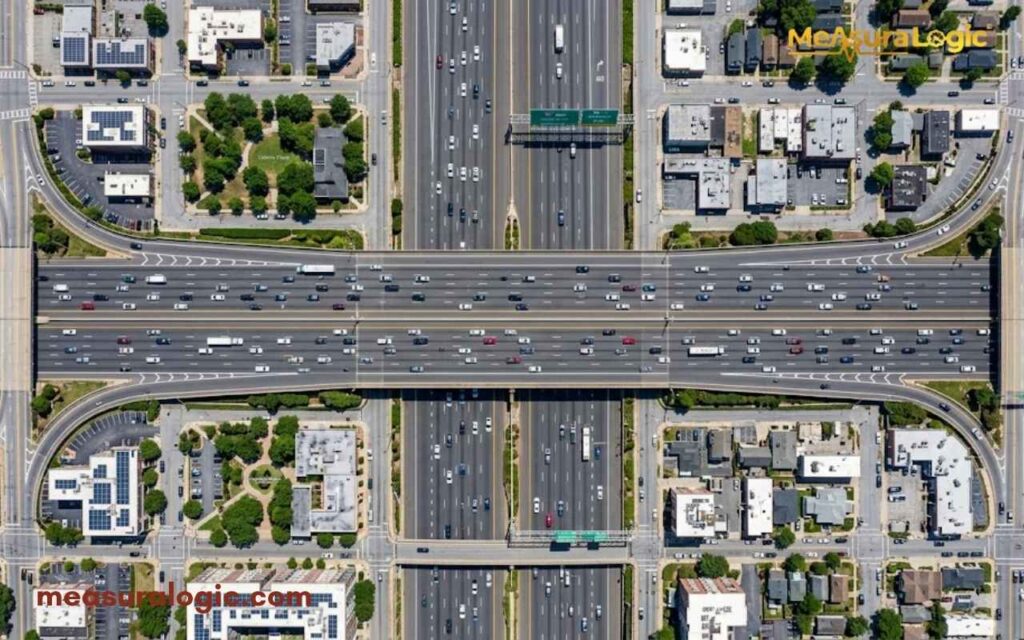
When we think of length, we usually think of things lying flat on the ground. But width works too! In the United States, a normal highway driving lane is 12 feet wide.
If you look at just the eight driving lanes packed side-by-side (without counting the extra emergency parking space on the sides), you get a total of 96 feet. Next time you stand on a bridge over a highway, look down at those eight lanes of traffic. It is a nearly perfect picture of what 100 feet looks like lying flat.
The Eastern Cottonwood Tree

In the wet areas of North America, the Eastern Cottonwood Tree grows very fast along rivers.
A tree expert will tell you that a healthy, fully grown Cottonwood averages right around 100 feet tall. While nature isn’t a perfect ruler, these giant trees are very consistent in reaching this height. Looking up at their huge leafy tops gives us a great way to see what 100 feet looks like in the great outdoors.
The Blue Whale

You cannot discuss 100 ft without mentioning the Blue Whale. This is the physical reality of the largest animal to ever exist on Earth. A mature Blue Whale can grow up to 98 to 100 feet in length.
To put this size into perspective, consider the blue whale heart. It is the size of a compact car, and its tongue alone weighs as much as a whole elephant. Lining up 20x the heart of a blue whale would roughly equal the length of its entire body. This marine giant is so large that it makes an Olympic Swimming Pool look cramped.
- Blue Whale Length: ~100 feet
- Blue Whale Heart Size: 5 feet (roughly the height of a small adult)
- Comparison: One whale is longer than two semi-trailers parked bumper-to-bumper.
Explore About How Big Is Chicago? Exploring the Size, Layout, and its Charm
The Hollywood Sign

Perched atop Mount Lee in the Santa Monica Mountains, the Hollywood Sign is a global icon of the Hollywood Hills. While the letters themselves are 45 feet tall, the entire structure—when considering the foundation and the height of the letters—occupies a significant vertical scale.
If you were to stack two of the letters (like the “H” and the “O”) on top of each other, you would reach 90 feet. Add a small base, and you have a 100-foot monument overlooking Los Angeles. This vertical measurement is a great way for tourists to visualize height in a famous geographic location.
Two Semi-Trucks and Full Trailers
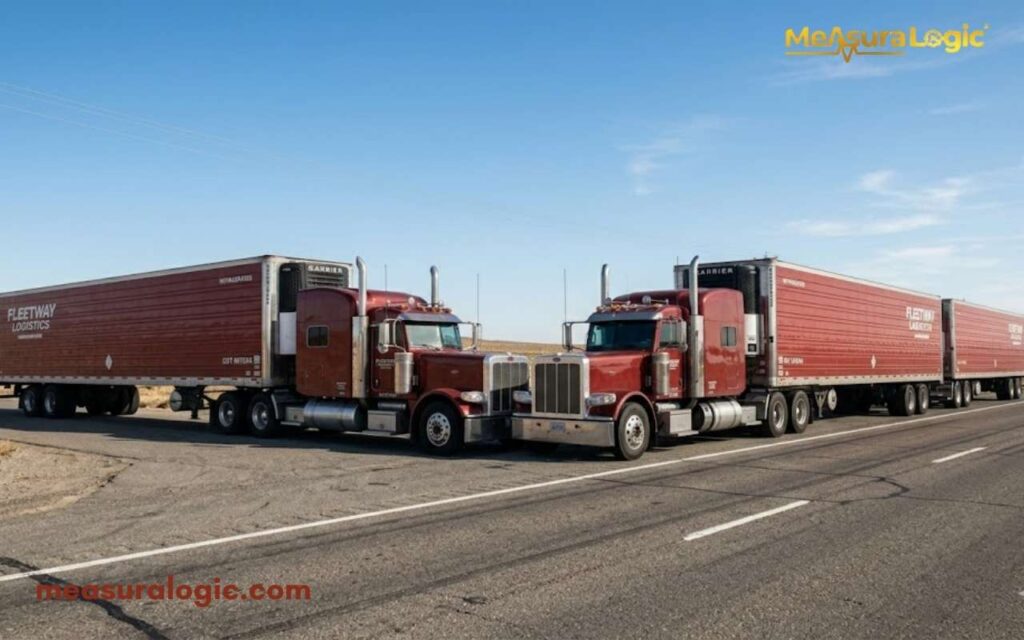
On the highways of North America, Semi-Trucks (Tractors and full trailers) are the lifeblood of commerce. A standard semi-trailer is usually 53 feet long. When you include the tractor (the cab), the total length of a single unit is about 70 to 80 feet.
However, if you look at two semi-trailers (the boxes themselves) parked end-to-end, you are looking at roughly 106 feet. For someone involved in real estate or construction planning, imagining two of these massive trucks parked along a property line is a quick way to estimate 100 feet without a length converter.
The 10-Story Building

In architecture, the “10-foot rule” is a common conversion used to estimate the height of commercial buildings, office buildings, and apartment complexes. Each floor, or story, typically accounts for 10 feet of vertical space (including the space for cables and pipes between floors).
Therefore, a 10-story building is the quintessential 100-foot landmark. Whether it is a low-rise apartment building or a mid-sized office tower, looking at the roof of the tenth floor gives you a perfect sense of this distance.
The NBA Basketball Court

An NBA Court is officially 94 feet long. While this is slightly under our target, most professional basketball courts are housed in facilities that provide at least three feet of “out-of-bounds” safety space behind each baseline.
When you measure from wall to wall in a standard professional or high school gymnasium, you are almost always dealing with a distance of 100 feet. This spatial estimation is easy for most people because we have all sat in the bleachers and looked across the hardwood.
| Venue Type | Primary Length | Gap to reach 100ft |
| NBA Court | 94 ft | +6 ft (Safety zones) |
| Tennis Court | 78 ft | +22 ft (Backcourt) |
| Bowling Lane | 60 ft | +40 ft (Approach/Machinery) |
| Cricket Pitch | 66 ft | +34 ft (Run-ups) |
A Standard Bowling Lane

A Standard Bowling Lane is often cited in measurement blogs, but the details matter. The actual playing surfacen from the foul line to the headpin is around 60 feet.
To reach 100 ft, you must include the “approach” area (where the bowler walks) and the “pit” (the machinery that resets the pins). The total length of the wooden or synthetic structure inside the building is remarkably close to 100 feet. It’s a perfect example of how dimensions can be deceptive if you only look at one part of a whole.
Find about 20 everyday Items That Are 7 Inches Long
The Olympic Swimming Pool

An Olympic-size pool is huge! These pools are 50 meters long, which is about 164 feet. To find 100 feet in the water, you wouldn’t swim the whole thing. You would need to swim just a little more than half the pool—about 60% of the way across.
If you are at a local community pool, which is usually 75 feet long, you would swim one full length plus one-third of the way back to hit the 100-foot mark. For swimmers, this is a great way to track how far they have gone!
Five Standard School Buses

A Standard School Bus is typically about 35 to 45 feet long. However, if you look at compact car or standard sedans, which average about 15 feet, the math changes.
To reach 100 ft using bumper-to-bumper logic:
- Option A: Approximately 2.5 school buses.
- Option B: almost 5 to 6 luxury RVs / Class C motorhomes.
- Option C: Roughly 7 standard sedans in a row.
These everyday objects make property evaluation much easier. If you can fit seven cars in front of a piece of land, that land has roughly 100 feet of road frontage.
10 Kayaks in a Row

For those who frequent campgrounds and marinas, kayaks are a familiar sight. A standard touring kayak is 10 feet long. This makes the math incredibly simple: line up 10x kayaks end-to-end, and you have reached almost 100 feet.
This is a favorite tool for spatial estimation because kayaks are uniform in size. Unlike trees or buildings, which can vary, a regulation kayak is a reliable “human-made” ruler for the great outdoors.
Learn About Tiny House Dimensions: Complete Guide to Sizes and Layouts
The Base of the Great Sphinx

While we often think of ancient monuments in terms of miles or kilometers, 100 feet was a significant measurement for ancient builders too. The Great Sphinx of Giza is much longer than most people realize. Its total length from the paws to the tail is about 240 feet.
If you were to cut the Sphinx in half, one half of that ancient limestone structure would be roughly 120 feet, just slightly over our 100 ft target. It helps to visualize that even thousands of years ago, humans were building on a scale that dwarfs our modern standard sedans.
40 Human Paces

If you find yourself in a field without any vehicles or buildings to use as a reference, you can always rely on your own body. The average adult human has a walking stride of about 2.5 feet.
To estimate 100 feet on the ground:
- Start at a fixed point.
- Walk in a straight line with normal, steady steps.
- Count to 40 paces.
This “head-to-toe” or “step-by-step” method is used by city planners and urban planning scouts during initial site visits. It is surprisingly accurate and requires zero equipment.
The 100 Feet Challenge: Can You Beat It?
Ready to test your imagination and estimation skills? Let’s make it a game.
Learn about 19 Items That Are 12 Inches Long
How It Works:
- Pick a space – a yard, park, or long hallway.
- Grab some objects – anything you can move: shoes, water bottles, sticks, or even books.
- Set a goal line – without measuring, estimate where 100 feet would end.
- Line up your objects – see how close your estimate comes to the real distance.
Level Up the Challenge:
- Time Trial: How fast can you walk or run 100 feet in a straight line? Try to beat your own record.
- Creative Line-Up: Make a “100-foot pattern” using your objects. Can you make shapes, a snake, or even a mini obstacle course?
- Friend vs Friend: Have a friend guess where the 100-foot mark is, then measure and see who was closest.
Bonus Tip: Try it indoors with books or chairs. It’s surprisingly tricky to estimate distances without looking at a ruler!
Conclusion
Now you know that 100 feet is not just a number, it is a distance you can actually see and feel. From a Blue Whale to a 10-story building, from kayaks to semi-trailers, these real-world examples help make this length tangible.
Whether you are walking, measuring a property, or just observing the world around you, you can use these references to estimate distances with confidence. Next time you hear “100 feet,” don’t just picture numbers—picture a whale, a row of cars, or a ladder reaching a rooftop.
Distance becomes real when you connect it to things you know. And now, 100 feet has a place in your everyday life.
FAQs about 100 feet
1. How many subway cars make up 100 feet?
A standard subway car is about 50–60 feet long, so two cars end-to-end roughly equal 100 feet.
2. Can a wind turbine blade reach 100 feet?
Yes! Many smaller wind turbines have blades around 100 feet long, roughly the same as a 10-story building.
3. How far is 100 feet in a swimming pool relay?
In a 25-yard pool, 100 feet is almost one full length plus a short turn, perfect for quick sprint comparisons.
4. How long is 100 feet in a train station platform?
A short commuter train platform can be around 100 feet, enough for two or three train cars to line up.
5. Is 100 feet enough for a zipline?
Yes! Many beginner ziplines are around 100–150 feet long, giving a thrilling but safe ride.
Read about 17 Common Things That Are 18 Inches Long (Real Life Examples)

Joss River is an experienced blogger at Measura Logic, focusing on all aspects of measurements. He uses his profound knowledge to demystify complex topics, covering everything from standard units and precision to the history and logic of various measuring systems. Joss helps readers achieve a deeper understanding and appreciation for accurate data and reliable measurements.